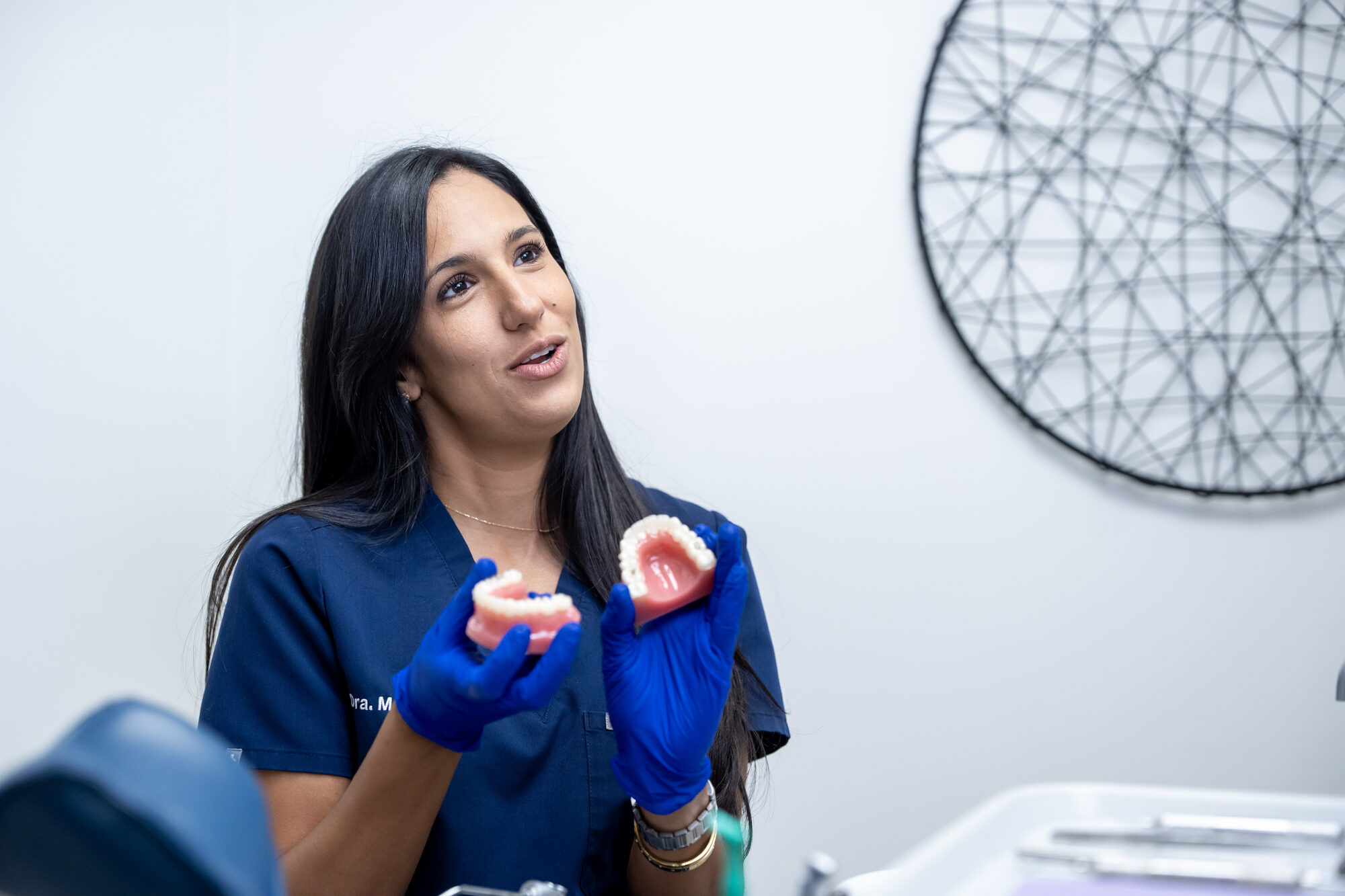
Invisalign
Clear Aligners
Straightening teeth without brackets. Useful on its own — and sometimes essential before restorative work, because a tooth in the wrong position cannot be restored well.
Price ranges, and what moves them →
Aligning before restoring, step by step
Illustrative diagram. Every case is planned on its own imaging.
How it works
A series of custom clear trays moves teeth in small increments. Each aligner is worn for one to two weeks before moving to the next. The sequence is planned digitally from a scan of your mouth, so the movement is mapped out before the first tray is made.
Small tooth-coloured attachments are usually bonded to some teeth. They give the aligner something to push against, and they are what make certain movements — rotations, intrusions — possible at all.
Who it suits
- Crowding and spacing of mild to moderate severity
- Relapse after previous orthodontic treatment, which is common and usually straightforward
- Adults who will not accept fixed brackets, which is an entirely legitimate reason
- Patients preparing for restorative work, where moving a tooth first makes a far better crown or implant possible
What it cannot do, honestly
Clear aligners are not a universal substitute for braces. Severe skeletal discrepancies, large rotations of round-rooted teeth, and cases needing significant bodily movement of roots are often better treated with fixed appliances or require orthodontic referral. A practice that says every case is an aligner case is selling, not diagnosing.
And the treatment depends almost entirely on you: the aligners work only while they are in your mouth. Twenty to twenty-two hours a day is not a suggestion. Patients who wear them less do not get slower results — they get different results from the ones that were planned, which is a harder problem to fix.
Why a prosthodontist is involved
Prosthodontics is concerned with how teeth meet and function together. When alignment is being changed in a mouth that also needs crowns, veneers or implants, those decisions cannot be made separately — where the tooth ends up determines what restoration is possible. Planning both together is the whole point.
Afterwards
Teeth move back. This is biology, not failure, and it applies to every orthodontic treatment ever performed. Retainers are not optional, and they are not temporary. Expect to wear one at night indefinitely if you want the result to hold.
Common questions
Start with a
Remote Consultation
A 30–60 minute video consultation with Dr. Díaz-Rubayo. Review your history, share records, and receive an honest assessment — from wherever you are.
Book Your ConsultationOr call (787) 765-8394